I've spent the last year watching something unfold that most people aren't paying attention to.
While the tech world obsesses over chatbots and image generators, three industries are quietly building AI infrastructure that will define the next decade of global operations. They're not tweeting about it. They're not launching flashy demos. They're embedding intelligence into the physical world in ways that create permanent competitive advantages.
Mining companies, energy operators, and agricultural businesses are deploying physical AI systems that make autonomous decisions in environments where mistakes cost millions or kill people. These aren't experiments. They're production systems processing trillions of data points, operating hundreds of autonomous machines, and generating measurable returns that dwarf anything happening in consumer AI.
The difference? These companies are building infrastructure they own.
What Physical AI Actually Means in Practice
Physical AI combines sensors, machine learning, and automation to make real-time decisions in demanding environments. The key word is real-time. We're talking about systems that analyze conditions and act in milliseconds, not minutes.
John Deere's autonomous tractors process camera images and determine if the path ahead is safe in approximately 100 milliseconds. The neural network runs locally on the machine—no cloud dependency, no latency, no data leaving the farm.
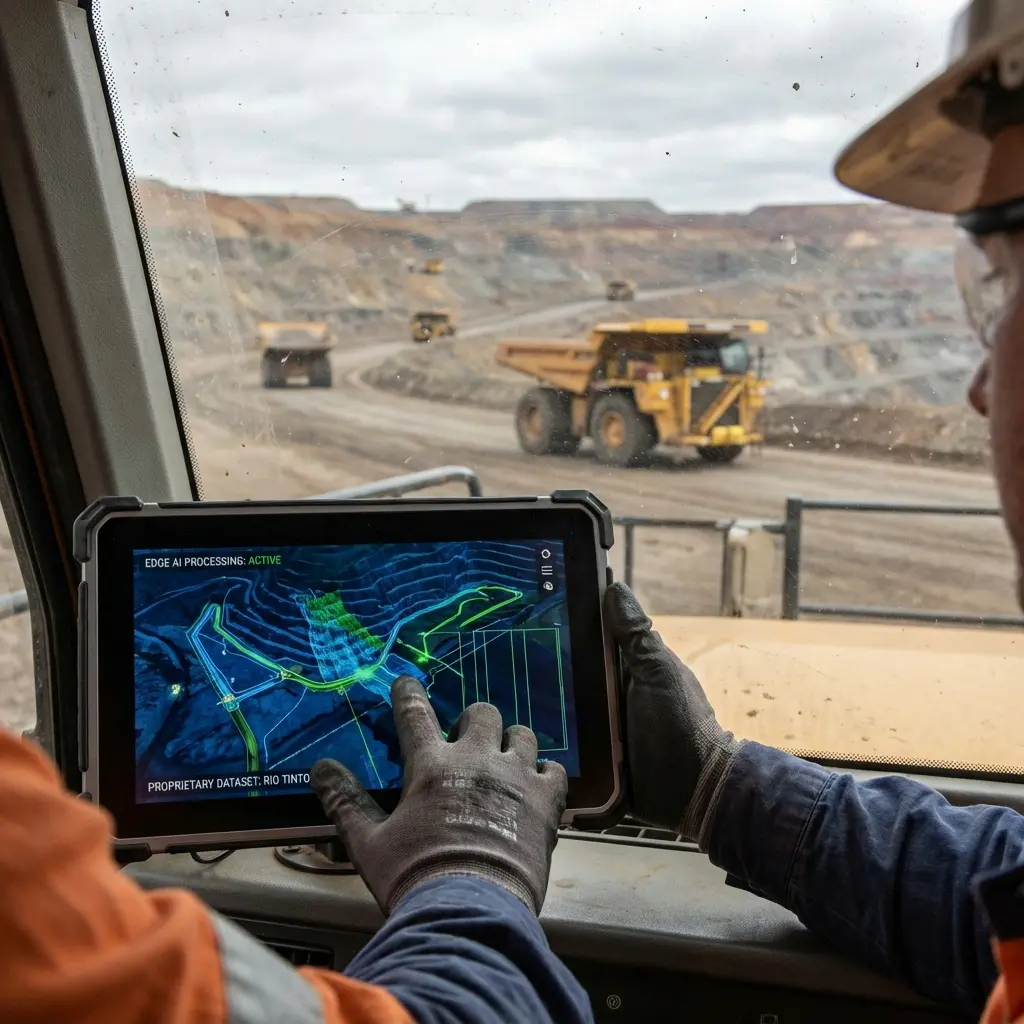
Rio Tinto operates over 400 autonomous haul trucks, each equipped with more than 45 electronic tags sending data every few seconds. That's over 30 million geo positions every single day, processed at the edge, building a proprietary dataset that represents a decade of accumulated operational intelligence.
Saudi Aramco deployed edge AI for autonomous drone operations and facility monitoring, training their industrial AI model on 7 trillion data points gathered over the company's 90-year history. In 2024 alone, they recorded $1.8 billion of AI-driven technology realized value.
These aren't proof-of-concept projects. These are operational systems that have crossed the threshold from experimentation to infrastructure.
The Ownership Advantage Nobody Talks About
Here's what I find most interesting about how these industries are deploying AI: they're treating it as owned infrastructure, not rented intelligence.
When Rio Tinto processes 30 million data points daily from autonomous trucks, that data stays within their systems. When John Deere's sprayers collect images and performance data, it feeds back into their platform in a continuous learning loop that makes their models progressively smarter with every acre sprayed.
This creates something most AI discussions completely miss: self-improving proprietary assets.
Traditional equipment depreciates. These AI systems appreciate through accumulated operational intelligence. The longer they run, the more valuable they become. The data they generate belongs to the operator, not a cloud provider building their own competitive advantages.
Rio Tinto's autonomous trucks operate 700 hours more than conventional haul trucks with 15% lower costs. That performance gap isn't just about the hardware. It's about the operational knowledge embedded in systems they control completely.
Edge Processing Changes the Economics Entirely
The shift to edge processing isn't just about data sovereignty. It fundamentally changes the cost structure of AI deployment.
In one manufacturing case study, edge AI reduced hardware requirements from 50 cards to just four—a 92% reduction. Hardware costs dropped from $225,000 to $18,000. Energy consumption fell proportionally.
Data centers already consume 1% of global electricity. Goldman Sachs projects this demand will surge 165% by 2030. Organizations building local edge infrastructure are converting what would be perpetual energy and subscription costs into owned, efficient assets.
John Deere equipped their machines with processing units designed to withstand temperatures from -40°F to extreme summer heat, with onboard GPUs performing tens of trillions of operations per second. These aren't cloud-dependent systems burning through API calls. They're self-contained intelligence that functions regardless of connectivity.
For mining and energy operations in remote locations, this changes everything. IoT devices like sensors, cameras, and spectrometers can run AI models at the edge to enable mineral processing or computer vision techniques without relying on the cloud or internet.
You can now deploy cutting-edge AI applications anywhere regardless of connectivity or compute limitations. The constraint isn't technology anymore. It's awareness that this approach exists.
The Competitive Moat That Compounds Over Time
I've watched companies struggle with the build-versus-buy decision for years. In physical AI, the answer is becoming clear: the companies building are creating advantages that can't be purchased later.
Rio Tinto's investment in AI and automation has created proprietary datasets that represent significant competitive advantages difficult for others to replicate. You can't buy a decade of autonomous truck operations data. You can't shortcut the learning loops that come from processing billions of sensor readings in real-world conditions.
The company's AI-powered geophysical mapping reduced traditional drilling campaigns from 18-24 months to 2-3 months. That's 6-12x faster. Factor in better targeting that eliminates wasted drilling, and the effective speed improvement for identifying economic drill targets reaches 100x.
John Deere's See & Spray technology uses 36 cameras and machine learning to identify and spray only weeds while moving at 12-15 mph. Farmers using this technology reduce chemical use by 70%. That's not just environmental performance. That's dramatic cost reduction through owned technology making micro-decisions locally.
These advantages compound. Every operational cycle generates data that improves the next cycle. Every improvement increases the gap between operators with mature AI infrastructure and those starting from zero.
What This Means for Data Sovereignty
Most organizations don't realize they're exposed until someone points it out.
When you use cloud AI services, you're not just renting processing power. You're contributing to training datasets that benefit your provider and potentially your competitors. The operational intelligence you generate flows into systems you don't control.
The mining, energy, and agriculture sectors recognized this early. These industries handle proprietary exploration data, operational processes, and competitive intelligence that represents billions in potential value. Feeding that into third-party systems wasn't an option.
Saudi Aramco's decision to train their industrial AI model on 90 years of proprietary data rather than using external cloud services demonstrates the calculation these companies are making. The data represents accumulated knowledge that defines competitive positioning. Maintaining control isn't a compliance requirement. It's strategic necessity.
Rio Tinto's Mine Automation System consolidates data from 98% of sites to provide operational insights using advanced algorithms. This centralized-yet-owned approach proves you don't need to choose between AI capability and data ownership. You can build infrastructure that delivers both.
The Implementation Reality Check
Physical AI deployment in these industries isn't plug-and-play. It requires diagnostic work, infrastructure assessment, and custom integration.
Deere's autonomous tractors didn't appear overnight. They resulted from systematic development of processing units, sensor arrays, and machine learning models designed for specific agricultural conditions. The neural networks had to function in extreme temperatures, process data in real-time, and operate without constant connectivity.
Rio Tinto's autonomous fleet required integration with existing mining operations, safety systems, and logistics networks. The AI had to learn operational patterns specific to their sites, equipment, and processes.
Aramco's edge AI deployment involved collaboration with technology partners to adapt industrial AI solutions for facility monitoring, predictive maintenance, and autonomous operations in energy infrastructure.
The common pattern: diagnostic first, integration second, replacement last.
These companies didn't rip out existing systems to chase AI trends. They assessed current infrastructure, identified bottlenecks, and built AI layers that enhanced rather than replaced operational foundations.
Why This Matters Beyond These Three Industries
The approaches these industries are taking reveal principles that apply across operational contexts.
Ownership over subscription. Building infrastructure you control creates assets that appreciate through accumulated intelligence rather than expenses that recur indefinitely.
Edge over cloud where it matters. Local processing eliminates latency, reduces costs, maintains data sovereignty, and enables operation regardless of connectivity.
Integration over replacement. Optimizing current infrastructure before introducing new dependencies prevents complexity bloat and preserves institutional knowledge.
Assets over efficiency metrics alone. AI infrastructure that increases business valuation and transferability matters more than time savings that disappear if you stop paying subscriptions.
Organizations in manufacturing, logistics, healthcare operations, and other physical industries face similar choices. The mining, energy, and agriculture sectors are providing a roadmap for how to approach AI as infrastructure rather than tooling.
The Awareness Gap Creates Opportunity
Most decision-makers don't know local AI infrastructure can match cloud performance. They don't realize edge processing can reduce costs by 92% while improving capabilities. They aren't aware that autonomous systems can function completely disconnected from external services.
This awareness gap explains why some organizations build competitive moats while others rent capabilities that never become assets.
Rio Tinto, John Deere, and Saudi Aramco aren't smarter than other companies. They recognized earlier that AI infrastructure represents a strategic choice between dependency and ownership. They invested in building capabilities rather than subscribing to services.
The technical barriers to local AI deployment have collapsed. Open-source models achieve performance parity with proprietary alternatives. Edge computing hardware handles processing that required data center infrastructure three years ago. The constraint isn't capability. It's awareness that the option exists.
What Physical AI Deployment Actually Requires
Building owned AI infrastructure isn't about having the biggest budget or the most advanced technology team. It requires specific organizational conditions.
Repeatable processes. AI optimizes patterns. Organizations with chaotic, constantly changing workflows can't benefit from automation until they establish consistency.
Willingness to invest in ownership. The economics favor owned infrastructure over subscriptions in the long term, but you have to be willing to invest upfront rather than spreading costs across monthly payments.
Diagnostic patience. Template solutions don't work in operational contexts. You need to audit current infrastructure, identify integration points, and build custom architectures.
Data sovereignty commitment. If you're willing to feed proprietary operational intelligence into third-party systems for convenience, you're choosing rental over ownership.
The mining, energy, and agriculture sectors met these conditions because their operational realities demanded it. High-risk environments, remote locations, and competitive intelligence concerns made ownership non-negotiable.
Other industries face the same choice with less obvious forcing functions. The question isn't whether you can build owned AI infrastructure. It's whether you recognize the value before competitors establish advantages that compound over time.
The Understated Revolution
Physical AI won't generate the headlines that chatbots do. Autonomous mining trucks don't have the viral potential of AI-generated images. Edge processing in agricultural equipment doesn't spark the same debates as large language models.
But physical AI is becoming fundamental infrastructure for the global economy. Mining operations that process materials for batteries, electronics, and construction. Energy systems that power everything else. Agricultural production that feeds populations.
These industries are embedding intelligence into operational foundations in ways that create permanent advantages. They're building systems that improve continuously, operate autonomously, and remain under their control.
The revolution is happening. It's just not happening where most people are looking.
I've seen this pattern before. The organizations that recognize infrastructure shifts early build positions that become unassailable. The ones that wait until the approach becomes obvious find themselves competing against accumulated advantages they can't replicate.
Physical AI in mining, energy, and agriculture represents that inflection point. The technology works. The economics favor ownership. The competitive advantages compound.
The question isn't whether this approach will define the next decade of operational AI. It's whether you'll recognize it in time to build rather than rent.