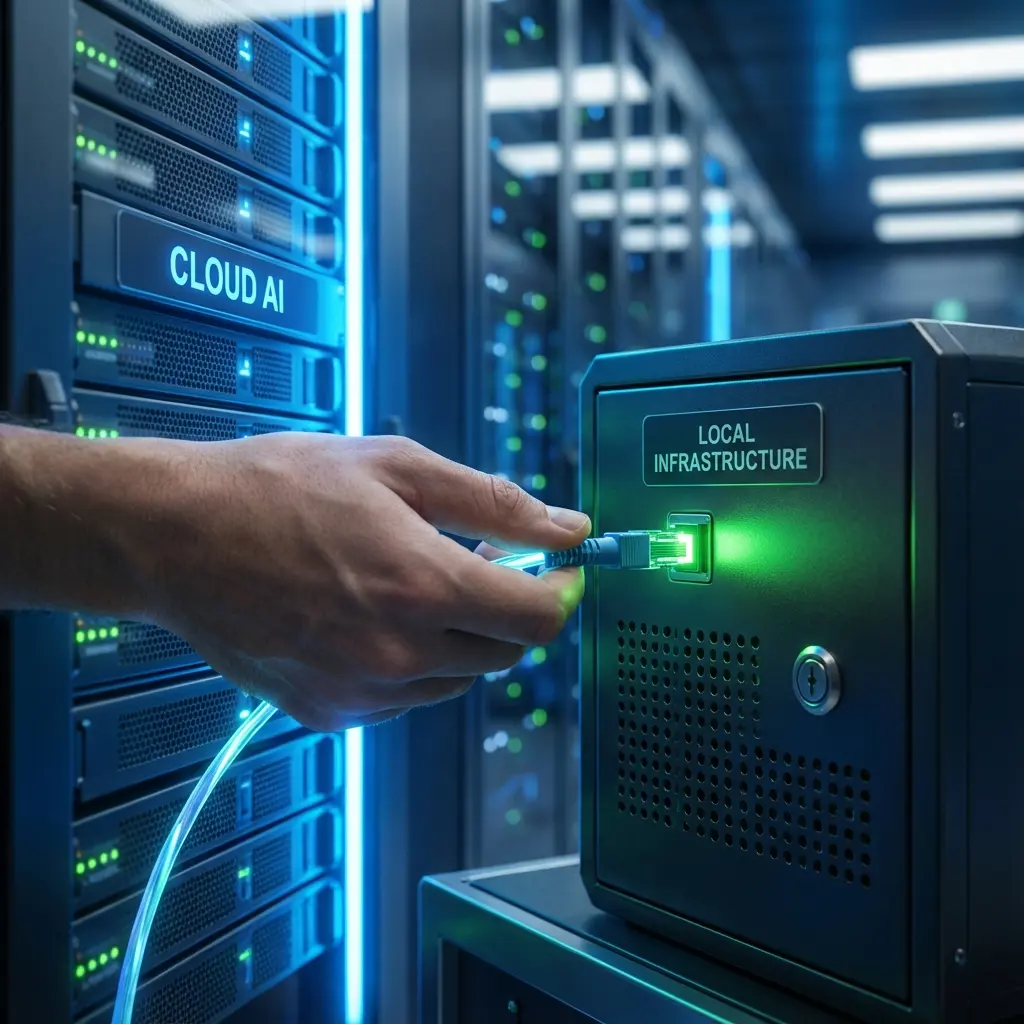
SGLang's Chunked Pipeline Parallelism just solved a problem that's been forcing organizations into cloud dependency: the memory wall that made large language models impossible to run locally without datacenter-scale hardware.
This isn't theoretical. SGLang generates trillions of tokens in production daily, running on over 400,000 GPUs across organizations including xAI, AMD, NVIDIA, LinkedIn, and Oracle Cloud.
The technique delivers 67.9% reduction in time-to-first-token while maintaining 82.8% scaling efficiency. For DeepSeek-V3.1 deployments, it produces 3.31× prefill throughput compared to standard configurations.
That performance gap represents something more valuable than speed metrics.
It represents the difference between renting intelligence and owning it.
Why Memory Became the Chokepoint
Large language models hit a wall when you try to run them locally. The wall is memory.
A 120-billion parameter model traditionally required multiple high-end GPUs just to load the weights. Then you needed additional memory for the KV cache that stores context during generation. Then more for batch processing multiple requests simultaneously.
The math pushed organizations toward two options: massive hardware investment or cloud APIs.
Most chose APIs. Convenient, scalable, no upfront capital.
But that convenience came with a hidden cost structure. Your proprietary data flows through external systems. Your usage patterns train their models. Your operational intelligence becomes their competitive advantage.
You're not buying a service. You're renting capability while subsidizing your vendor's asset accumulation.
How Chunked Pipeline Parallelism Breaks the Pattern
The innovation addresses memory constraints through architectural efficiency rather than hardware multiplication.
Traditional pipeline parallelism splits a model across multiple devices, with each device handling specific layers. The problem: pipeline startup latency scales with total sequence length, creating bottlenecks for long-context operations.
Chunked Pipeline Parallelism processes input in chunks rather than waiting for complete sequences.
The result: startup latency becomes proportional to chunk size, not total sequence length. Memory requirements drop because you're not holding entire sequences in memory simultaneously. Throughput increases because devices spend less time idle.
The implementation details show how this plays out in production environments. When scaling to PP4 TP8 with 12K chunk sizes, the system outperforms TP32 configurations by 30.5% while using fewer total resources.
This isn't just faster processing. It's a fundamental shift in what hardware can accomplish.
The Accessibility Threshold Just Dropped
Hardware requirements tell the real story about ownership viability.
A 120-billion parameter model now runs on a single 80GB GPU like the NVIDIA H100 or AMD MI300X. That's workstation-grade hardware, not datacenter infrastructure.
For Mixtral 8x7B with 5-bit quantization, you need 32.3 GB of memory. Dual RTX 3090 or RTX 4090 setups handle it. Equipment you can purchase outright and depreciate as a business asset.
DeepSeek's Multi-head Latent Attention mechanism compresses KV cache by 93.3% compared to earlier architectures. That compression directly translates to serving more concurrent users on the same hardware.
The math changes when memory efficiency improves. Higher concurrency without proportional hardware expansion means your infrastructure scales without linear cost increases.
Cloud APIs scale linearly. More usage equals more cost, forever.
Owned infrastructure scales sub-linearly. More usage hits capacity limits, but optimization and architectural improvements extend those limits without subscription increases.
The ROI Window That Makes Ownership Feasible
High-traffic enterprise applications sometimes reach $10,000 to $40,000 monthly in inference compute costs through cloud APIs.
Organizations that optimize batching and caching reduce those costs by 25-45% without affecting user experience. But they're still renting.
The ownership calculation becomes interesting when you map those recurring costs against capital investment in local infrastructure.
A workstation with dual high-end GPUs represents 3-6 months of cloud API costs for moderate-volume operations. The hardware becomes a business asset that appears on your balance sheet. The intelligence it generates stays within your organizational boundaries.
More importantly: the infrastructure becomes sellable.
When you build a business on rented APIs, your AI capabilities evaporate if you stop paying. When you build on owned infrastructure, your AI systems become part of business valuation during acquisition or sale.
The buyer isn't just getting your processes. They're getting the intelligence infrastructure that embodies your operational knowledge.
Where the Sovereignty Advantage Compounds
78% of organizations now use AI in at least one business function. That adoption rate means competitive dynamics are shifting.
Companies that understand open-source LLMs can leverage them for automation, insight, and innovation without data exposure. Companies that default to cloud APIs are unknowingly training their vendors' models with proprietary information.
The exposure isn't malicious. It's structural.
When you send data to external APIs, you're accepting terms of service that often include rights to use that data for model improvement. Your customer interactions, your process optimizations, your domain-specific knowledge—all flowing into systems that benefit your vendor and potentially your competitors.
Local deployment eliminates that exposure entirely. Your data never leaves your infrastructure. Your usage patterns remain private. Your competitive intelligence stays proprietary.
This matters more as AI becomes central to operations rather than peripheral tooling.
The Optimization Shift That Defines 2026
A lot of LLM performance progress in 2026 will come from improved tooling and inference-time scaling rather than from training or core model advances.
That shift has implications for where competitive advantage accumulates.
When progress comes from training, advantage goes to organizations with the most compute and data. When progress comes from inference optimization, advantage goes to organizations with the deepest implementation expertise.
SGLang represents that second category. The models are open-source. The hardware is increasingly accessible. The differentiator becomes optimization knowledge and architectural sophistication.
Organizations that develop internal expertise in inference optimization build sustainable advantages. Organizations that outsource to APIs are betting that convenience outweighs control.
That bet made sense when local deployment required datacenter infrastructure and specialized expertise that few possessed.
It makes less sense when workstation-grade hardware can match cloud performance and open-source tooling handles the complexity.
What This Means for Infrastructure Decisions
The memory barrier breaking doesn't mean cloud APIs become obsolete. It means the forced choice between performance and ownership disappears.
You can now achieve cloud-equivalent performance with local control.
The decision becomes strategic rather than technical. Do you want to rent intelligence or own it? Do you want to build assets or pay for access? Do you want your operational knowledge to remain proprietary or flow into external training systems?
Those questions have different answers depending on your organization's situation.
If you're in early-stage experimentation, APIs make sense. Low commitment, fast iteration, minimal infrastructure investment.
If you're building core operational infrastructure that will run for years, ownership economics favor local deployment. The capital investment converts recurring expenses into depreciating assets. The sovereignty protects competitive intelligence. The infrastructure becomes transferable business value.
The Diagnostic Question That Reveals Readiness
Not every organization should rush to build local AI infrastructure.
The viability threshold requires repeatable processes worth automating. If your operations are chaotic or constantly changing, automation compounds dysfunction rather than creating leverage.
The readiness question: Do you have standardized workflows that would benefit from intelligent automation, and are you willing to invest in ownership rather than rental?
If yes, the technical barriers just dropped significantly.
If no, focus on process standardization first. Infrastructure optimization multiplies whatever you feed it. Feed it chaos, get amplified chaos. Feed it repeatable value creation, get scalable advantage.
Where We Go From Here
SGLang's Chunked Pipeline Parallelism represents more than a technical improvement. It represents infrastructure democratization.
The tools that were exclusive to organizations with datacenter budgets now run on hardware you can purchase outright. The performance that required cloud APIs now happens within your organizational boundaries. The intelligence that leaked into external systems now stays proprietary.
This doesn't solve every AI implementation challenge. You still need diagnostic work to identify automation opportunities. You still need integration expertise to connect AI capabilities to existing workflows. You still need realistic expectations about what current technology can and cannot accomplish.
But the memory wall that forced dependency on external infrastructure just cracked.
The organizations that recognize this shift will build different infrastructure than those that don't. They'll accumulate assets instead of expenses. They'll maintain sovereignty instead of accepting exposure. They'll own intelligence instead of renting it.
The choice between convenience and control used to require sacrificing performance.
That trade-off just disappeared.